
You’ve been told to breathe deeper, but your tight chest and forward head make it feel impossible. This page shows you how posture limits your breathing and gives you a routine to fix both at the same time.
In short: Posture and breathing are directly linked: poor alignment restricts lung expansion, while weak diaphragm control encourages slouching. The evidence is strong that fixing one improves the other, so do them together, 5-10 minutes daily, to see results fastest.
Quick picks
Our shortlist for this job · tap one to see today's price
Supports your spine so your chest can expand freely while you practice breathing.
Gentle cue helps you find neutral spine without straining, making breathing easier.
Before you start: check your body’s readiness
Stop and talk to a doctor first if you have chest pain, shortness of breath at rest, or recent thoracic surgery. These are warning signs that need prompt care. There is more on managing energy after a heavy lunch in a separate guide.
If you have a stable condition like mild scoliosis or arthritis, you can usually proceed with gentle movements. Always listen to your body: if an exercise causes sharp pain, stop immediately.
Consider doing a quick check-in with your primary care provider if you have a history of respiratory issues like asthma or COPD, to ensure these gentle movements are safe for you.
- No dizziness or lightheadedness
- No sharp chest or back pain
- You can stand or sit with support if needed
Safety first: If you feel faint or your breathing becomes labored, stop and rest. This is a sign to consult a professional.
Warm-up: wake up your ribs and spine
Spend 2 minutes moving gently to increase blood flow to your thoracic and cervical spine. This makes the later breathing and posture work more effective. Stiff joints resist movement, so warming up first prevents strain. We cover knowing when a workout is causing actual damage in a guide of its own.
- Thoracic rotations: Stand tall, hands on shoulders. Rotate your upper back to the right, then left. 10 reps each side.
- Neck stretches: Tilt your ear to your shoulder, hold for 15 seconds each side. Keep your shoulders down.
- Scapular squeezes: Pull your shoulder blades together and down. Hold for 5 seconds. Repeat 10 times.
These movements open up the joints that get stiff from slouching. You should feel a gentle release in your upper back before starting the main routine.
Exercise 1: diaphragmatic breathing for deep expansion
This exercise retrains your diaphragm to move fully, which pulls your posture into alignment. It suits anyone who breathes shallowly into their chest. Shallow breathing keeps your upper body tense, while deep breathing relaxes the back and opens the chest. The other half of this decision is how to position yourself for sleep.
- Lie on your back or sit up tall with your feet flat on the floor.
- Place one hand on your chest, one on your belly.
- Breathe in slowly through your nose for 4 counts, feeling your belly rise.
- Breathe out slowly through pursed lips for 6 counts, feeling your belly fall.
- Do 5-10 breaths.
Form cue: Your chest hand should stay still. All movement comes from the belly. If your chest rises, you are using your accessory muscles, not your diaphragm.
The lumbar support keeps your spine neutral so your diaphragm can fully engage without compensation.
- For convenience and durability, we upgraded and lengthened the straps to fit more
- 𝐔𝐏𝐆𝐑𝐀𝐃𝐄 & 𝐔𝐍𝐈𝐐𝐔𝐄 𝐁𝐀𝐂𝐊 𝐒𝐔𝐏𝐏𝐎𝐑𝐓 𝐏𝐈𝐋𝐋𝐎𝐖: If you spend a lot of time sitting on office
Exercise 2: posture resets that open your ribcage
These movements counteract the effects of sitting. They are best done after every hour at a desk. The goal is to create space between your ribs so breathing becomes easier. Slouching compresses the thoracic cavity, limiting lung expansion.
- Wall angels: Stand with your back against a wall. Press your head, shoulder blades, and hips to the wall. Raise your arms overhead, keeping your elbows and back touching the wall. 10 reps.
- Thoracic extension over foam roll: Lie with a foam roll under your mid-back. Support your head with your hands. Gently extend your back over the roll. 5-10 reps.
Form cue: Keep your core gently braced to avoid arching your lower back. Slow down if you feel a pinching sensation in your ribs.
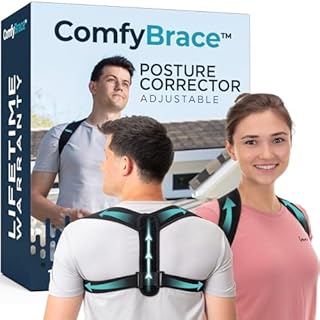
Wearing the posture corrector for 5 minutes after this exercise helps lock in the new spinal alignment while your muscles reset.
- Say Hello to a Pain-Free Life- The Comfy Brace posture corrector aims to relieve
- Innovative Design - Our proprietary design is orthopedically created to correct your
How to progress safely without overdoing it
Start with 5 minutes of breathing and 1 minute of posture work daily. After two weeks, add one set to each exercise. Consistency is key; short daily sessions are better than long weekly workouts.
- Week 1-2: 5 breaths, 10 wall angels
- Week 3-4: 10 breaths, 15 wall angels
- Week 5+: 15 breaths, 20 wall angels, add thoracic extension
Progress is when you feel less restricted in your chest and notice your shoulders dropping naturally. Track how easily you can take a deep breath after sitting at a computer for an hour. You should notice a difference within three weeks of consistent practice.
Pro tip: Don’t chase intensity. Consistency matters more. Five minutes daily beats one hour once a week. For the detail, see our notes on fix bad posture.
When to stop and see a professional
Stop this routine and consult a physical therapist or doctor if you experience any of the following. These are signs that the issue is structural or medical, not just habit. Self-exercise has limits, and knowing when to stop is part of the process.
- Worsening back or neck pain that radiates
- Numbness or tingling in your arms
- Shortness of breath that doesn’t improve with rest
- Loss of bladder or bowel control
A professional can assess your specific spine and lung function to create a targeted plan. They can also rule out underlying conditions that might be mimicking poor posture.
The bottom line
Start with diaphragmatic breathing and wall angels daily. Get a lumbar support pillow if you sit for long hours, and add a posture corrector if your chest stays tight. Your next step is to set a timer for 5 minutes today and do your first breathing set.
- For convenience and durability, we upgraded and lengthened the straps to fit more
- 𝐔𝐏𝐆𝐑𝐀𝐃𝐄 & 𝐔𝐍𝐈𝐐𝐔𝐄 𝐁𝐀𝐂𝐊 𝐒𝐔𝐏𝐏𝐎𝐑𝐓 𝐏𝐈𝐋𝐋𝐎𝐖: If you spend a lot of time sitting on office
Frequently asked questions
Can bad posture cause breathing problems?
Yes. Slouching compresses your ribcage and limits how far your lungs can expand. This can make breathing feel shallow. Fixing posture creates space for better lung capacity.
How many minutes of breathing exercises per day are enough?
Most people see benefits from 5 to 10 minutes daily. Consistency is more important than duration. Start small and build up gradually over a few weeks.
Is it okay to do these exercises after surgery?
Only if your surgeon or physical therapist clears you. Check with your doctor first. Gentle breathing can help prevent complications, but posture work must be approved by your care team. For the detail, see our notes on building a strong upper back.
Do breathing exercises help with stress?
Yes. Diaphragmatic breathing activates your parasympathetic nervous system, which calms your body. It is a simple, drug-free way to lower stress hormones and relax tight muscles.