
You feel stiff after a long day at your desk and wonder if workouts actually fix your slouch. This page explains the physical mechanism of how muscle strength changes your alignment.
In short: Exercise improves posture by strengthening weak muscles and lengthening tight ones, which allows your spine to maintain neutral alignment with less effort. The evidence for this biomechanical link is strong in sports medicine. Consistent movement is the most effective long-term fix for postural strain.
Our pick
Tap to see today's price on Amazon
Helps you roll out tight chest and back muscles before you start your posture routine.
Before you start this routine
Most healthy adults can do these exercises safely, but check with a doctor if you have a known spinal injury or severe pain. The routine works for people who feel postural fatigue after sitting or standing for long periods. If that sounds like your bench, read up on men's preventive care next.
Always warm up first. Cold muscles are more prone to strain, so gentle movement helps prepare your body for the specific posture work ahead. The other half of this decision is stay mentally healthy.
- Stop if you feel sharp pain. Dull fatigue is normal, but sharp sensations signal a stop.
- Check for numbness. Tingling in your hands or feet is a warning to see a doctor.
- Respect your limits. Do not force a stretch if it feels like a pinch rather than a stretch.
Safety first: If you have a history of back surgery or diagnosed spinal conditions, consult a physical therapist before starting any new routine.
Warm up to activate your core
A two-minute warm-up raises your heart rate slightly and increases blood flow to the muscles you will use. This makes the subsequent exercises more effective and reduces the risk of strain.
Focus on moving through your range of motion gently. The goal is to wake up the nervous system, not to exhaust yourself before the main work begins. Try standing tall and reaching for the ceiling, then slowly fold forward.
- Standing spine twists
- Shoulder rolls forward and back
- Cat-cow stretches on all fours
Rolling your upper back on a foam roller loosens tight muscles before you start the strengthening phase.
- High-density foam roller in Black
- Ideal for balance, strengthening, and flexibility exercises
Fix rounded shoulders with push-ups
Most forward-head postures stem from weak upper back muscles and overly tight chest muscles. Strengthening the posterior chain pulls your shoulders back into a neutral position.
Standard push-ups target the chest and triceps, but the variation below focuses on the upper back to counteract that slouch. Keep your elbows close to your body to engage the lats better. The other half of this decision is posture exercise course.
- Start in a high plank position.
- Pull your shoulder blades together as you lower your chest.
- Push back up while keeping that scapular retraction.
- Do 10 to 15 reps for two sets.
Form cue: Keep your core tight and avoid letting your hips sag.
Strengthen your mid-back with rows
Rowing movements are critical for pulling the shoulder blade toward the spine. This strengthens the rhomboids and middle trapezius, which are often dormant in desk jobs.
You can use a resistance band or light dumbbells. The goal is controlled tension, not heavy weight. Poor form with heavy weight can worsen postural issues.
- Stand on a resistance band or hold two light dumbbells.
- Hinge forward at the hips, keeping a neutral spine.
- Pull the weight to your lower ribs, squeezing your shoulder blades.
- Lower slowly over three seconds.
- Do 10 to 12 reps for three sets.
Form cue: Do not shrug your shoulders toward your ears. Keep them down and back.
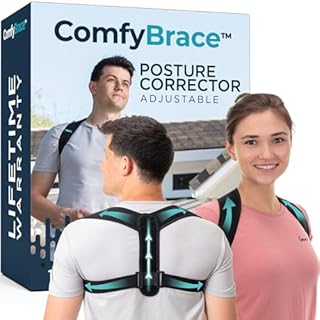
Wearing this during the workday reminds you to keep your shoulders back while you build the muscle strength.
- Say Hello to a Pain-Free Life- The Comfy Brace posture corrector aims to relieve
- Innovative Design - Our proprietary design is orthopedically created to correct your
Align your spine with core bracing
Your core is the center of your posture. If your abdominal muscles are weak, your lower back often arches to compensate, leading to pelvic tilt issues.
Bracing exercises train your trunk to hold a stable, neutral position. This reduces the load on your lower back throughout the day. Imagine a belt tightening around your waist.
- Stand with your feet hip-width apart.
- Exhale fully and pull your belly button toward your spine.
- Hold this braced position for 10 seconds.
- Release and repeat 10 times.
Form cue: Keep breathing normally and do not hold your breath.
How to progress safely
Start with the basic form listed above for two weeks. Once you can complete the reps without losing alignment, you can increase the difficulty. Listen to your body and rest if needed. We go through relieving tension in tight shoulders step by step in its own article.
Progression can come from adding a set, increasing the hold time, or using slightly more resistance. Never skip the warm-up or the form cues. Track your progress in a notebook.
- Week 1-2: Two sets of 8-10 reps.
- Week 3-4: Three sets of 10-12 reps.
- Month 2: Add one set or increase band tension.
Pro tip: Consistency beats intensity. Doing the basic form perfectly three times a week is better than heavy weight with bad form once a week.
When to stop and see a professional
Exercises help most people, but they are not a cure for structural spinal issues. If you have persistent pain, seek medical advice. Do not push through severe discomfort.
You should see a doctor or physical therapist if you experience numbness, weakness, or pain that travels down your limbs. These are signs of nerve compression that require professional evaluation.
- Pain that does not go away with rest.
- Loss of bladder or bowel control.
- Leg or arm weakness that affects daily tasks.
Do not wait for these severe symptoms. Chronic postural pain is often manageable with targeted care, but it starts with a correct diagnosis. Early intervention is key.
The bottom line
To fix your posture, strengthen your upper back and core while stretching tight chest muscles. Start with the basic routine and use a foam roller for mobility. If you have pain, see a doctor before starting. We cover exercises to work on posture in a guide of its own.
- High-density foam roller in Black
- Ideal for balance, strengthening, and flexibility exercises
Frequently asked questions
How long does it take for exercise to change posture?
Most people see improved muscle endurance in two to three weeks. Structural changes in alignment take longer, often three to six months of consistent practice. Be patient with the process.
Does bad posture make exercise harder?
Yes. Poor alignment changes the leverage in your joints, making movements less efficient. It can also lead to compensatory patterns that cause injury. Improving posture usually makes lifting and running feel easier.
Can a posture corrector replace exercise?
No. A corrector provides external support but does not strengthen the muscles underneath. It is best used as a reminder to hold good posture while you build the internal strength to maintain it.
What exercises are best for desk workers?
Rows, reverse flys, and thoracic extensions are ideal. These target the upper back muscles that get weak from sitting. Add core bracing to support the lower spine as well.