
You want a structured posture course with exercises that actually teaches you where to move, not just a list of stretches. This page gives you a clear, step-by-step routine to fix slouching, plus the equipment and cues you need.
In short: This is a step-by-step posture course with exercises designed for beginners and intermediate users who want to improve their spine and core stability. You should perform the full routine 3 to 4 times a week, doing about 60 to 90 seconds per exercise. It focuses on deep core activation and shoulder retractions to build lasting good posture.
Quick picks
Our shortlist for this job · tap one to see today's price
Supports your lumbar curve at the office, making it easier to practice good sitting form while you work.

Relaxes the upper back and shoulder muscles so you can perform the posture exercises with less resistance.
Before you start: clear the deck
Before you begin a posture course with exercises, it is good to know that a gentle stretching program is generally safe for most people. The evidence for these standard exercises is based on physiotherapy and general anatomy principles, though specific clinical trial data on ‘posture’ itself can be mixed. We cover personal fitness definition in a guide of its own.
You should get medical clearance from a doctor or physical therapist if you have a diagnosed spine condition, a recent injury, or severe pain. Start slowly and never push into sharp pain.
Safety warning signs: Stop the exercise and see a doctor if you experience sharp or shooting pain, numbness in your arms or legs, or pain that gets worse when you stand up or walk.
- Consult a professional if you have unexplained lower back pain that lasts more than a few days.
- Check with a doctor if you have a history of spinal stenosis or spondylolisthesis.
Safety first: If you have any spinal surgery or a known degenerative disc condition, consult a healthcare provider before doing these exercises.
Warm-up to get your body ready
A warm-up prepares your muscles and joints for the movement. This section focuses on loosening the chest and upper back, which are often tight and pull you forward. For the detail, see our notes on how to sleep properly at night posture.
You will do two main movements: a gentle neck mobility drill and thoracic rotation. You can also use a foam roller or body roller to help release the upper back muscles before the main course.
Rolling it along your upper back helps loosen the tight muscles that pull your shoulders forward.
- 3D textured rollers measure 12.5 x 5.5 inches with triple massage zones to replicate
- Roll before and after your work out at the gym , Pilates , or yoga to condition and
Exercises 1 & 2: Neck and Shoulders
These two exercises address the upper trapezius and the levator scapulae, the muscles most responsible for the hunched ‘computer neck’ posture. Loaders in this spot often ask about band exercises for posture as well.
Exercise 1: Neck Flexion and Extension. Gently move your head forward and back, not side to side.
- Sit or stand tall with your shoulders relaxed.
- Slowly tilt your chin to your chest (flexion).
- Hold for 5 seconds, then gently tilt your head back to look at the ceiling (extension).
- Hold for 5 seconds.
- Do 8 to 10 repetitions.
Exercise 2: Shoulder Blade Squeeze. This teaches you to retract your shoulder blades, which is the core of good posture.
- Stand or sit upright.
- Draw your shoulder blades down and back as if squeezing a small towel.
- Keep your chin parallel to the floor; do not arch your neck back.
- Hold for 5 to 10 seconds.
- Do 10 to 15 repetitions.
Exercises 3 & 4: Core and Spine
A strong core is the foundation for your posture. Without it, your lower back will round forward. These two moves are foundational.
Exercise 3: Glute Bridge. This strengthens the glutes and helps you avoid an anterior pelvic tilt.
- Lie on your back with knees bent and feet flat on the floor.
- Squeeze your glutes and lift your hips until your knees, hips, and shoulders form a straight line.
- Hold the top for 5 seconds.
- Lower your hips slowly to the floor.
- Do 2 sets of 15 repetitions.
Exercise 4: Bird-Dog. This improves your balance and your ability to hold your spine neutral while moving.
- Start on all fours (hands under shoulders, knees under hips).
- Extend your right arm forward and your left leg backward.
- Keep your hips square to the floor; do not let your lower back dip.
- Hold for 3 to 5 seconds, then return to the start.
- Do 10 repetitions on each side.
Pro tip: A yoga mat will make these core exercises more comfortable and prevent your hands and knees from slipping. It helps to understand posture improvement movements before going further.
Exercise 5: The 'Superman' Hold
The Superman exercise is a direct test of your back extensors, the muscles that physically hold your spine up against gravity.
Do not hold your breath; breathe steadily throughout the movement. If you have no lower back issues, this is one of the best single exercises in this posture course with exercises.
- Lie flat on your stomach on the floor.
- Extend your arms straight in front of you and lift them a few inches off the floor.
- Simultaneously lift your legs a few inches off the floor.
- Hold the position for 10 to 15 seconds.
- Release, rest for 5 seconds, and repeat for 3 to 5 sets.
Exercise 6: Wall Angels for Upper Back
Wall Angels force your upper back into a neutral position against a solid surface. It is a very effective exercise if you spend all day slouching over a desk.
- Stand with your back, head, and heels flat against a wall.
- Slide your arms up the wall as if making the letter ‘H’, keeping your elbows and wrists in contact.
- Slide your arms down and back up. Aim for 10 to 15 smooth repetitions.
- Keep your shoulders down; if you arch your back, you are doing it wrong.
Summary: Your Complete Posture Course Table
Here is a quick reference table to guide you through the full posture course with exercises. You can use this as a checklist for each session.
| Exercise | Sets/Time | What it Helps | Easier Version |
|---|---|---|---|
| Neck Flexion & Extension | 10 reps | Reduces neck tension | Move only halfway |
| Shoulder Blade Squeeze | 15 reps | Opens chest, strengthens upper back | Starts with a light towel grip |
| Glute Bridge | 2 sets of 15 | Strengthens glutes, fixes pelvic tilt | Only lift hips a few inches |
| Bird-Dog | 10 reps each side | Improves balance and core stability | Only lift arm, not leg |
| Superman Hold | 5 holds of 10s | Builds back extensors | Only lift arms or legs |
| Wall Angels | 15 reps | Upper back mobility and posture | Slower, smaller range of motion |
How to progress safely and check your form
Starting a new exercise routine can feel awkward, but the key is to focus on form, not speed. The best way to check your posture is to have someone take a photo of you standing from the side and compare it to a standard postural line.
For a beginner posture course, progress by adding one set to your exercises every two weeks, or by holding the position for five more seconds. Do not rush to add more weight or intensity. There is more on strengthening muscles for upright standing in a separate guide.
When to seek professional help: If the pain is not mechanical (like stiffness from inactivity) or if it radiates down your arms or legs, you need a physical therapist’s assessment.
Pro tip: Use a posture corrector like the ComfyBrace for 5-10 minutes a day to remind your body of the neutral position while you learn the exercises.
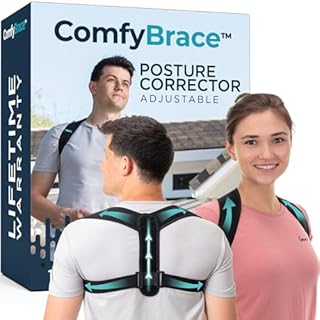
Wearing it for short periods while you practice the course gives you real-time feedback on your shoulder position.
- Say Hello to a Pain-Free Life- The Comfy Brace posture corrector aims to relieve
- Innovative Design - Our proprietary design is orthopedically created to correct your
The bottom line
The best way to fix poor posture is a consistent routine of 3 to 4 times a week focusing on the upper back and core. Start with the 7 exercises in this guide and use a posture corrector for short daily reminders. The next step is to get a good lumbar support for your chair to hold your spine in place while you sit.
- 𝗔𝗹𝗹 𝗗𝗮𝘆 𝗖𝗼𝗺𝗳𝗼𝗿𝘁 - High-grade memory foam contours to your spine, delivering lumbar
- 𝗗𝗿𝗶𝘃𝗲 𝗦𝗺𝗮𝗿𝘁 - The Samsonite back support features a compact profile and adjustable
Frequently asked questions
Can breathing exercises actually improve posture?
Breathing exercises do not directly change your skeleton, but they help you activate your diaphragm and your core. Proper diaphragmatic breathing reduces tension in the chest and upper neck, which makes it easier to maintain an upright posture. Think of it as a tool to support the physical work, not a standalone fix.
How do I find free posture exercises PDFs?
Many medical associations and university physical therapy programs publish free posture exercises PDFs online. Look for resources from accredited health bodies like the American Council on Exercise or university extensions. Always verify that the PDF is from a trusted, academic source rather than a random blog.
Are posture exercises with pictures better than video?
Pictures and static images are often better for complex form cues because you can pause and study the alignment of your spine. For a beginner posture course, a static diagram is easier to compare your own body against than a moving video. If that sounds like your bench, read up on fixing posture with therapy next.
How long will it take to see good posture results?
You will likely feel less stiff within two weeks of consistent practice. Visible changes in your resting posture usually take six to eight weeks, as the muscles and connective tissues have to adapt to the new, neutral position. Consistency is the most important factor.