
You are looking for lower back relief that does not hurt your joints or require complex gym equipment. This page gives you a clear, step-by-step routine of water-based movements to soothe stiffness and build gentle strength.
In short: Water exercises are a strong, well-supported option for many people with chronic lower back pain because the buoyancy reduces spinal load. This routine suits beginners and those with joint sensitivity; perform it 2 to 3 times a week for 15 to 20 minutes. The goal is steady, pain-free movement that improves circulation and core stability without high-impact strain.
Quick picks
Our shortlist for this job · tap one to see today's price
Provides safe, gentle warmth to ease muscle tension after your water session.

Creates low-impact resistance in the water to strengthen back and shoulder muscles.
Before you start: safety and clearance
Before you jump in, make sure the pool is clean and at a temperature that feels comfortable, usually between 83 and 88 degrees Fahrenheit. If you have a specific spinal injury or chronic condition, get a quick okay from your doctor or physical therapist first. We cover low impact aquatic workout plans in a guide of its own.
Water is forgiving, but you can still strain a muscle if you move too fast or hold your breath. Keep your movements slow and let the water support your weight.
- Stop immediately if you feel sharp pain, tingling, or numbness in your legs or groin.
- Do not proceed if you have an open wound, active infection, or a fever.
- Pause if you feel dizzy or short of breath; stand still and rest.
Safety first: If you experience loss of bladder or bowel control, or pain that gets worse over time, seek medical care promptly. We go through assessing your posture step by step in its own article.
Warm-up: getting your body ready for water
A short warm-up helps your muscles respond better to the exercise. Spend three to five minutes moving gently before you start the main routine.
- March in place: Stand in chest-deep water and lift your knees for 30 seconds. Let the water resistance help with the effort.
- Arm circles: Make large, slow circles with your arms, 10 forward and 10 backward.
- Neck stretches: Gently tilt your head to one side, hold for 10 seconds, and repeat on the other side.
Move 1 and 2: gentle support for the spine
These two moves focus on decompressing the spine and engaging the deep core muscles that support your lower back.
- Assisted Forward Bend: Stand with your feet hip-width apart. Hold the pool edge or a float for light support. Hinge at your hips and let your head and torso hang forward. Hold for 20 to 30 seconds. Perform 3 sets.
- Standing Knee-to-Elbow: Stand tall. Slowly bring your right knee to your chest, then reach your left elbow to the opposite side. Alternate sides. Do 10 of each side.
Form cue: Keep your neck long and avoid letting your head drop into your chest during the forward bend.
Move 3 and 4: building hip and glute strength
Strong hips and glutes take pressure off the lower back. These exercises use the water’s natural resistance to build stability. If that sounds like your bench, read up on upper back posture stretches next.
- Standing Hip Abduction: Stand in shallow water with your feet together. Lift one leg out to the side against the water. Do 15 repetitions on each side. Perform 2 to 3 sets.
- Aquatic Clamshells: Lie on your side in a pool with a float under your head. Keep your knees bent. Lift your top knee while keeping your hips stacked. Do 15 repetitions per side.
Form cue: Focus on using your outer hip muscles, not swinging your leg with momentum.
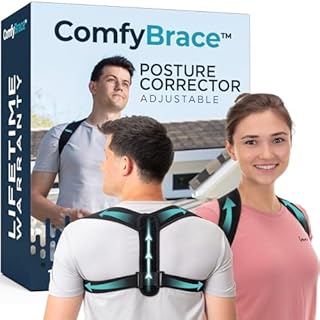
Helps you maintain proper spinal alignment during the standing portions of your routine.
- Say Hello to a Pain-Free Life- The Comfy Brace posture corrector aims to relieve
- Innovative Design - Our proprietary design is orthopedically created to correct your
Move 5 and 6: core control and stability
A stable core is the foundation of a healthy back. These movements challenge your balance and midsection in a safe, low-impact way.
- Modified Plank: Get into a push-up position in the water. Perform a plank by holding your body straight, letting the water support you. Hold for 15 to 30 seconds. Do 3 sets.
- Dead Bug Reverse: Lie on your back with your legs in the air. Slowly lower one knee while extending the opposite arm. Alternate for 10 reps.
Form cue: Keep your lower back from arching too much into the water or the pool floor.
Your 7-move water exercise summary
This table gives you the quick reference for the full routine. Use it as a checklist for your 15-to-20-minute session.
| Exercise | Sets or Time | What It Helps | Easier Version |
|---|---|---|---|
| Assisted Forward Bend | 3 sets, 30s | Spinal Decompression | Hold onto float for more support |
| Knee-to-Elbow | 10 reps/side | Core & Rotation | Move slower and smaller |
| Standing Hip Abduction | 2-3 sets, 15 reps | Glute Strength | Stand in deeper water for support |
| Aquatic Clamshells | 2 sets, 15 reps | Hip Stability | Do lying on pool floor |
| Modified Plank | 3 sets, 30s | Core Stability | Shorten the hold time |
| Dead Bug Reverse | 2 sets, 10 reps | Core Control | Only move the legs |
| Aquatic Marching | 1 minute | Circulation | March in place without arms |
A warm compress can be used after the session to soothe residual muscle tension.
- 𝐈𝐍𝐒𝐓𝐀𝐍𝐓 𝐖𝐀𝐑𝐌𝐓𝐇, 𝐄𝐕𝐄𝐑𝐘𝐃𝐀𝐘 𝐂𝐎𝐌𝐅𝐎𝐑𝐓: Engineered with advanced heat technology, this
- 𝐗𝐋 𝐂𝐎𝐕𝐄𝐑𝐀𝐆𝐄 𝐅𝐎𝐑 𝐂𝐎𝐌𝐏𝐋𝐄𝐓𝐄 𝐅𝐋𝐄𝐗𝐈𝐁𝐈𝐋𝐈𝐓𝐘: At 12” × 24”, this heat pad for pain relief wraps
How to progress safely over time
Once these seven moves feel easy, you can increase the challenge. The best way to progress is by adding more resistance or holding positions for longer.
- Use a resistance band: A standard pool-safe band around the waist or ankles adds gentle tension to the hip abduction exercise.
- Increase hold time: Try to hold your modified plank for an extra 10 seconds.
- Add a second set: Perform two full rounds of the entire 7-move routine.
Listen to your body. If you start feeling stiffness or soreness that lasts more than a day, take an extra rest day. There is more on aqua core lumbar moves in a separate guide.
When to stop and see a professional
Exercises are a tool for management, not a fix for every type of back pain. You should talk to a doctor or physical therapist if the pain does not improve after two weeks of consistent exercise.
Be especially careful if you have a history of fractures, unexplained weight loss, or symptoms that appear in your legs.
Pro tip: If you are starting a new routine, a physical therapist can give you a personalized plan based on your specific spine health.
The bottom line
For most people, the water routine is the safest and most comfortable way to move a stiff lower back. Start with the seven-move circuit 2 or 3 times a week. If you want to progress beyond the water, a comfortable posture corrector can help support your spine during long hours of sitting.
- Say Hello to a Pain-Free Life- The Comfy Brace posture corrector aims to relieve
- Innovative Design - Our proprietary design is orthopedically created to correct your
Frequently asked questions
Can I do water exercises if I can't swim?
Yes. Many of these moves, like the assisted forward bend and standing hip abduction, can be done in chest-deep water where your feet remain on the bottom. You do not need to be a strong swimmer to get the benefits.
How often should I do this routine?
You should perform this routine two to three times per week. For many people, this frequency provides enough consistency to improve mobility and reduce stiffness without overtraining the muscles. Loaders in this spot often ask about constricted muscle fibers as well.
What if the water is too cold?
Cold water can make your muscles tense up, which might increase pain. Aim for a temperature between 83 and 88 degrees Fahrenheit. If you are at a public pool, check the temperature first or bring a warm towel to use between sets.
Do I need special equipment for the pool?
You only need basic items to stay safe. A foam float or pool noodles are helpful for support. As you get stronger, you might add a water-specific resistance band, which is much more durable than the land-based ones.
Is water exercise better than yoga for back pain?
It depends on your specific issue. If you have joint pain or high levels of stiffness, water exercise is generally easier on the body. Yoga may be better for building deep flexibility and balance. Many people find that doing both on different days provides the best results.